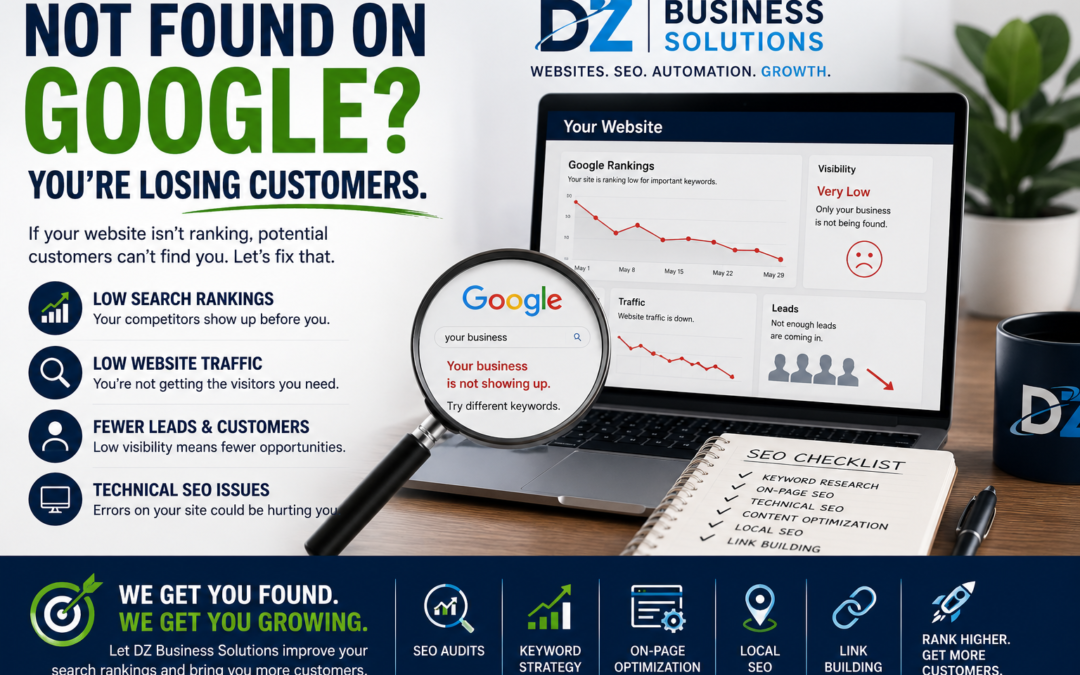
If your website feels invisible on Google, you’re not alone. Many small business owners invest in a website, post on social media, and still wonder why calls and leads don’t increase. Often, the issue isn’t your business—it’s a few common SEO problems keeping your site from showing up when customers are actively searching.
Below are the most common SEO issues we see, why they matter, and practical ways to improve them without chasing trends or gimmicks.
1) Your pages aren’t targeting the right keywords
One of the biggest SEO problems is simply focusing on the wrong search terms. Many websites try to rank for broad phrases that are too competitive (or not specific to what you actually sell). Others don’t target any keywords at all—they just have general service pages with vague headings.
Why it matters
If your pages don’t match what customers type into Google, your site won’t appear for the searches that drive calls, bookings, and purchases. Strong SEO starts with relevance.
What to do
- Build one strong page per core service (instead of cramming everything on one page).
- Use service + location phrases where appropriate (e.g., “roof repair in [city]”).
- Write headings and page titles that clearly reflect what you offer.
2) Weak or missing on-page SEO (titles, headings, and internal links)
Even a well-designed website can struggle if key on-page elements aren’t set up correctly. Common issues include duplicate page titles, missing H1 headings, thin content, and no internal links connecting related pages.
Why it matters
Search engines rely on your page structure to understand what each page is about. If those signals are unclear or inconsistent, your site may not rank well—even if your services are great.
What to do
- Give every page a unique, descriptive title tag and meta description.
- Use a clear H1 and supporting H2s based on your services and customer questions.
- Add internal links (for example: homepage → service pages → contact page).
3) Your site is slow or frustrating on mobile
Many SEO problems start with performance. If your site loads slowly, has oversized images, or is hard to use on a phone, visitors leave quickly—and that sends negative signals.
Why it matters
Most local customers search on mobile. If your site doesn’t load fast and feel easy to navigate, you lose potential customers before they even see what you offer.
What to do
- Compress images and remove unnecessary scripts and plugins.
- Make sure buttons are easy to tap and phone numbers are clickable.
- Keep pages clean, readable, and focused on one next step.
4) Your Google Business Profile isn’t fully optimized
For local businesses, your Google Business Profile (GBP) can be just as important as your website. A missing, incomplete, or inconsistent listing is a major SEO issue—especially if competitors have stronger profiles.
Why it matters
Google often shows map listings before traditional website results. If your profile isn’t optimized, you’re less likely to appear in the local pack where high-intent customers click.
What to do
- Choose the right primary category and add relevant secondary categories.
- Add services, descriptions, photos, and regular updates.
- Make sure your business name, address, and phone number match your website exactly.
5) Inconsistent business information across the web
If your address, phone number, or business name varies across directories (Yelp, local listings, industry sites), it can create confusion for search engines and customers. This is often overlooked, but it’s a common root cause behind weak local rankings.
Why it matters
Search engines look for consistent signals when deciding which businesses to show in local results. Mismatched info can reduce trust and visibility.
What to do
- Audit your core listings and correct outdated contact details.
- Standardize formatting (Suite vs. Ste., dashes vs. no dashes, etc.).
- Maintain one consistent version of your business info everywhere.
6) You don’t have enough quality content to compete
Many small business websites have a homepage and a few service pages—and that’s it. That can work in some cases, but in competitive markets, you often need additional content to answer customer questions and capture more search traffic.
Why it matters
Helpful content builds topical relevance and gives your site more opportunities to rank. It also helps customers trust you before they pick up the phone.
What to do
- Create FAQs and short supporting pages that address specific customer concerns.
- Publish blog posts that focus on common problems, comparisons, and local considerations.
- Keep content practical and specific—written for customers, not just search engines.
7) Low trust signals: few reviews, weak testimonials, or unclear credibility
SEO isn’t just technical. If people land on your site and don’t trust it, they leave. Google can’t “see” your service quality, but it can see patterns that suggest users aren’t finding what they need.
Why it matters
Trust impacts conversions. And better conversions often support better performance over time. Reviews, testimonials, and clear service details can make the difference between a visitor and a lead.
What to do
- Request reviews consistently and respond professionally.
- Add testimonials and proof (photos, certifications, case examples) where appropriate.
- Make it easy to contact you with clear calls-to-action.
How DZ Business Solutions can help
SEO problems can be tough to spot because they often involve multiple small issues compounding over time. DZ Business Solutions helps small businesses improve visibility by focusing on the basics that actually move the needle: clear site structure, strong service pages, local optimization, technical cleanup, and a content strategy that matches how customers search.
If you suspect your website isn’t pulling its weight, a quick review can usually reveal what’s holding you back—and what to fix first.
Ready to Grow Your Business Online?
DZ Business Solutions helps businesses with website design, SEO, automation, AI solutions, reputation management, and digital marketing strategies that drive growth.
Whether you’re launching a new business or looking to attract more customers, we’re here to help.